Evaluating the Niger Flag Isolated on White Background for Digital and Print Projects
Selecting the correct visual asset for national representation requires careful consideration of format, resolution, and stylistic rendering. When sourcing imagery for the Republic of Niger, designers and content creators often encounter two distinct variations: a standard flat vector representation and a 3D illustration of the Niger Flag Isolated on White Background. Understanding the functional differences between these assets is essential for ensuring the final output meets professional standards across various media, from digital presentations to physical merchandise.
Defining the Asset Specifications
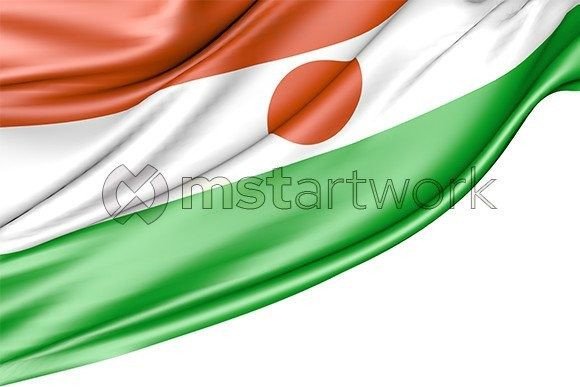
The specific asset in question is a high-resolution JPG file with dimensions of 3840×2160 pixels. This 16:9 aspect ratio aligns with standard ultra-high-definition video and presentation formats. The "isolated on white background" designation indicates that the flag does not include environmental context, shadows cast upon other objects, or complex backgrounds. Instead, it exists as a self-contained element against a pure white canvas (#FFFFFF). This isolation is a critical technical feature that facilitates post-production editing, allowing users to extract the flag using selection tools or blend modes without manually masking out intricate scenery.
It is important to distinguish between the flat graphic version and the 3D illustration mentioned in the product description. A flat graphic offers geometric precision and uniform color, suitable for official documentation or small-scale icons. In contrast, the 3D illustration introduces simulated lighting, fabric texture, and depth. This rendering style mimics how a physical flag appears when draped or waving, providing a tactile quality that flat vectors lack. Evaluators must determine which aesthetic aligns with their project's tone before acquisition.
Strategic Applications Across Media
The versatility of this asset stems from its resolution and neutral background. For digital integrations, the 3840×2160px resolution ensures clarity on modern displays. When used in slide decks or web headers, the white background allows for seamless compositing over light-themed layouts. However, the utility extends significantly into print-on-demand (POD) and physical manufacturing.
- Social Media and Web Graphics: The isolated nature allows for quick resizing and placement within templates. The 3D effect can increase engagement rates by adding visual interest compared to static clip art.
- Apparel and Textiles: For t-shirts, baby clothes, and kids' apparel, the 3D shading provides a sense of realism that translates well to direct-to-garment (DTG) printing. The high pixel density prevents pixelation when scaled down for chest prints or up for back prints.
- Paper Products and Stationery: Greeting cards, scrapbooking elements, and posters benefit from the clean edges. The white background serves as a safe zone for trimming during the printing process.
- Promotional Merchandise: Mugs, stickers, and heat transfer projects require sharp delineation between the subject and the substrate. An isolated file reduces the labor required to prepare the image for production.
Benefits of the 3D Illustration Style
Choosing a 3D rendered Niger Flag Isolated on White Background over a traditional 2D vector offers specific advantages in commercial and creative contexts. The primary benefit is perceived value. Three-dimensional rendering suggests effort and modernity, making it preferable for marketing materials where visual impact drives user attention. Additionally, the simulated folds and lighting create natural focal points, guiding the viewer’s eye across the composition rather than presenting a static block of color.
From a technical workflow perspective, the white background simplifies the removal process. While PNGs with transparency are ideal, a high-contrast JPG against white allows most design software to generate accurate masks automatically. This efficiency is valuable for bulk production environments, such as POD fulfillment centers, where manual editing time directly impacts profitability.
Tradeoffs and Technical Considerations
Despite its versatility, this specific file format presents limitations that evaluators must weigh. The most significant constraint is the JPG format itself. Unlike SVG or EPS files, JPG is a raster format composed of pixels. While 3840×2160px is substantial, it has a finite scaling limit. Enlarging this image beyond 100% for large-format signage or billboards will result in visible artifacts and softness. Users requiring infinite scalability should seek vector alternatives instead.
Furthermore, the white background, while useful for light themes, creates friction for dark-mode designs. Removing a white background to place the flag on a black or colored surface can sometimes leave a faint white halo or fringe around the edges. This requires additional refinement in editing software. If the primary use case involves dark interfaces, a pre-masked PNG with transparency or a version isolated on black may be a more efficient starting point.
Color accuracy is another consideration. The flag of Niger consists of orange, white, and green horizontal bands with an orange circle. Screen calibration varies, and JPG compression can occasionally shift color values. For official government or diplomatic use, strict adherence to Pantone or CMYK color standards is mandatory. A 3D illustration, by definition, applies gradients and shadows that alter the base colors. Therefore, this asset is better suited for decorative, educational, or commercial purposes rather than official protocol where flat, exact color matching is required.
Decision Framework: When to Use This Asset
Determining whether this specific Niger Flag Isolated on White Background fits your needs requires matching the asset's properties to your project goals. This file is a strong fit if you are creating digital content for 4K screens, designing merchandise where a realistic texture enhances the product appeal, or working on light-background layouts where edge blending is straightforward. It is particularly effective for educational materials, travel blogs, and cultural celebrations where the goal is to evoke a sense of place through stylized representation.
Conversely, alternatives should be considered in specific scenarios. If the project involves large-format outdoor advertising, a vector file is necessary to maintain crisp edges at massive scales. If the design requires strict diplomatic protocol, a flat, officially sanctioned graphic is safer than a stylized 3D render. Finally, if the workflow demands frequent recoloring or manipulation of individual flag elements, a layered PSD or AI file would offer greater control than a flattened JPG.
Practical Implementation Insights
For those proceeding with this asset, proper handling ensures optimal results. When preparing for print-on-demand services, always convert the RGB JPG to the printer’s required CMYK profile to prevent unexpected color shifts, particularly in the vibrant orange band. Test the isolation mask at the intended print size; what looks clean on a monitor may show jagged edges when printed on fabric. For web use, consider converting the JPG to WebP format to reduce file size without sacrificing the visual fidelity of the 3D details.
Ultimately, the decision rests on balancing aesthetic preference with technical requirements. The Niger Flag Isolated on White Background in 3D illustration form serves as a robust middle-ground asset. It bridges the gap between sterile iconography and complex photography, offering a versatile solution for creators who need national symbolism that feels contemporary and tangible. By understanding both its capabilities and its boundaries, users can integrate this design effectively into presentations, apparel, and digital media while maintaining professional quality.