Evaluating Yemen Flag Isolated on White Background Assets for Professional and Creative Projects
When sourcing national symbols for digital or print media, the technical specifications of the asset are just as critical as the symbolic accuracy. A Yemen flag isolated on white background serves a specific functional purpose in design workflows: it provides a clean, high-contrast canvas that facilitates easy extraction, layering, and integration into diverse layouts. Unlike flags photographed in natural environments with wind distortion or complex lighting, an isolated asset offers consistency. For professionals aged 20 to 50 managing presentations, e-commerce listings, or educational materials, understanding the distinction between a standard raster image and a specialized 3D illustration at 3840×2160px resolution is essential for making informed procurement decisions.
Distinguishing Raster Isolations from 3D Illustrations
The market for flag assets is generally divided into two categories: flat vector-style rasters and rendered 3D illustrations. While both may be described as "Yemen flag isolated on white background," they serve different end goals. A flat isolation typically presents the flag in a static, rectangular form with uniform lighting. This is often sufficient for government documents, academic papers, or simple iconography where neutrality is paramount.
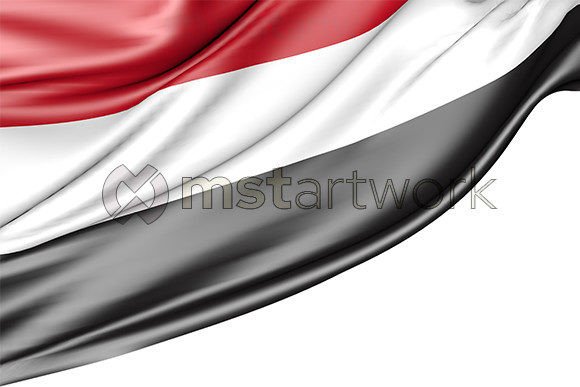
In contrast, a 3D illustration introduces depth, texture, and simulated fabric physics. When evaluating a 3840×2160px JPG file in this style, you are acquiring an asset that mimics real-world presence without the messiness of a photograph. The folds and shadows inherent in a 3D render provide visual cues that help the flag sit naturally atop other design elements. For social media graphics or merchandise like t-shirts and mugs, this added dimensionality often results in higher engagement because the object feels tangible rather than clinical. However, this stylistic choice comes with tradeoffs; a 3D render is less appropriate for strict diplomatic protocols where exact geometric proportions must be maintained without artistic interpretation.
Resolution and Format Considerations for Multi-Use Licensing
The specified resolution of 3840×2160px (4K UHD) places this asset in a versatile middle ground for creators. For web-based projects, social media posts, and digital presentations, this resolution is more than adequate, ensuring crisp edges even on high-DPI retina displays. The 16:9 aspect ratio aligns perfectly with modern slide decks and video thumbnails, reducing the need for cropping or padding that can degrade image quality.
However, users intending to utilize this Yemen flag isolated on white background for large-format printing or apparel must evaluate the physical output size. At a standard commercial print resolution of 300 DPI, a 3840×2160px image yields a maximum print area of approximately 12.8 by 7.2 inches. This is ideal for:
- Standard letterhead and document headers
- Chest-sized prints on t-shirts and hoodies
- Mug wraps and sticker designs
- Greeting cards and scrapbooking elements
If your project requires billboard-scale printing or full-bleed wall art exceeding these dimensions, this specific JPG format may require upscaling via AI tools or sourcing a vector alternative. Conversely, for baby clothes, kids' clothes, and small paper products, this resolution provides ample headroom for resizing without pixelation, making it a cost-effective single-source solution for product lines.
Comparative Analysis: Isolated Assets vs. Environmental Photography
Designers frequently debate whether to use an isolated asset or a contextual photograph. Choosing a Yemen flag isolated on white background offers distinct advantages in workflow efficiency, though it lacks narrative context.
Workflow Efficiency: An isolated asset eliminates the need for time-consuming masking or background removal. Even with advanced selection tools, removing a sky or crowd from a flag photo often leaves artifacts around the edges, particularly with the red, white, and black horizontal bands of the Yemeni flag. A pre-isolated JPG ensures clean boundaries, which is crucial when applying heat transfer paper or creating stickers where edge definition determines production quality.
Versatility vs. Authenticity: Environmental photos convey emotion and place, making them superior for journalism or travel content. However, they are poor candidates for composite design. If you are building a comparison chart of Middle Eastern nations or designing a corporate presentation template, environmental photos introduce visual noise and inconsistent lighting. The isolated 3D illustration strikes a balance, offering the aesthetic appeal of a real object while maintaining the neutral utility required for templates and overlays.
Evaluating Suitability for Print-on-Demand and Merchandise
For entrepreneurs and creators in the print-on-demand space, the decision often hinges on how the asset interacts with various substrates. The 3D illustration style of this Yemen flag isolated on white background presents unique opportunities and limitations compared to flat graphics.
On dark garments, the white background of the source file serves as a guide for placement but must be removed or blended during the printing setup. Because the 3D render includes internal shading, it tends to look more premium on fabric than a flat color block, which can appear cheap or like a decal. The simulated texture helps the ink blend visually with the garment weave. However, creators should verify that the shadow details in the 3D render do not conflict with the texture of the target material. For example, a heavily textured linen shirt might clash with a smooth digital silk render, whereas a smooth cotton tee would complement it.
For hard goods like mugs and phone cases, the 3D aspect ratio allows for dynamic wrapping. The 16:9 format can be cropped to focus on the central emblematic area or stretched to fit cylindrical surfaces. Compared to vector files which can sometimes look sterile on curved objects, the pre-rendered lighting of a 3D JPG can simulate curvature, making the final product appear more cohesive.
Decision Factors: When to Choose This Asset Over Alternatives
Selecting the right resource requires matching the asset’s characteristics to the project’s constraints. Below is a practical framework for determining if this specific Yemen flag isolated on white background is the correct choice.
Opt for the 3D Isolated JPG When:
- Presentation Speed is Priority: You need a professional-looking visual immediately for a slide deck or report and lack the time to render a 3D scene or hire an illustrator.
- Consistency Across Assets: You are creating a series of materials (e.g., a set of country profile cards) and need uniform lighting and perspective that only a standardized 3D asset can provide.
- Digital-First Delivery: The primary consumption method is screens (social media, websites, digital downloads), where 3840×2160px is optimal and vector scalability is unnecessary.
- Small-to-Medium Physical Products: Your print requirements stay within the 12x7 inch safe zone at high DPI, such as stickers, badges, or children's apparel.
Seek Alternative Formats When:
- Strict Geometric Compliance is Required: Government or military specifications demand exact Pantone colors and proportional ratios that artistic 3D renders may approximate rather than replicate perfectly.
- Large Format Printing: You intend to print banners, vehicle wraps, or posters larger than A2 size, where JPG compression artifacts or pixel density becomes visible.
- Color Editing is Necessary: You need to adjust the specific shade of red or black to match a brand palette. Raster JPGs are destructive to edit; vectors or layered PSDs are superior for color grading.
- Transparent Background Integration: While the white background is easy to remove, if you plan to use the flag hundreds of times across varying colored backgrounds, sourcing a native PNG with transparency or a vector file will save significant cumulative processing time.
Technical Best Practices for Integration
To maximize the value of this asset, users should adopt specific handling techniques based on the output medium. For web and social media, always export a compressed copy rather than using the full 3840×2160px master file. Unoptimized 4K images slow down page load speeds and consume user data without providing perceptible quality benefits on mobile devices. Resize to 1920×1080px or lower depending on the platform’s recommended specs.
For heat transfer and craft projects, test print a swatch first. The white background in the source file represents "no ink" for most transfer papers, but screen calibration varies. Ensure your printer profiles are calibrated so the red and black bands match expected outputs. The 3D shading may print darker than anticipated on absorbent materials like cotton; adjusting brightness curves before printing can compensate for ink soak-in.
Finally, when using this Yemen flag isolated on white background in scrapbooking or greeting cards, consider the emotional tone. The 3D style is modern and polished, suitable for celebratory or informational contexts. If the project involves historical reflection or somber remembrance, a flatter, more muted treatment or a documentary-style photograph may be more culturally and tonally appropriate. Understanding these nuances ensures the asset serves not just as a graphic element, but as a respectful and effective communication tool.